

Inflatable vs Rigid SUP: Which Paddle Board Is Right for You?
The inflatable vs. rigid SUP debate has been settled for most paddlers — but not in the way the traditional paddling community expected. Modern fusion drop-stitch inflatables have closed the performance gap with hard boards to the point where the remaining advantages of rigid boards apply to a narrow set of situations. Here's the honest comparison.
The Case for Inflatable SUPs
Storage and Transport
This is the category where inflatables are simply unmatched. A quality inflatable SUP packs into a bag the size of a large piece of luggage, weighs 20–30 lbs, and fits in the trunk of any car. Hard boards require a truck, a roof rack, or a trailer — and the storage space to match. For anyone without a dedicated garage or a vehicle built around hauling boards, an inflatable is the only practical choice.
Travel is another dimension where inflatables win decisively. You can check an inflatable SUP as luggage on a commercial flight. A hard board cannot go on a plane at all without freight shipping. If you want to paddle on a trip, your inflatable goes with you.
Durability on Rivers and Rocks
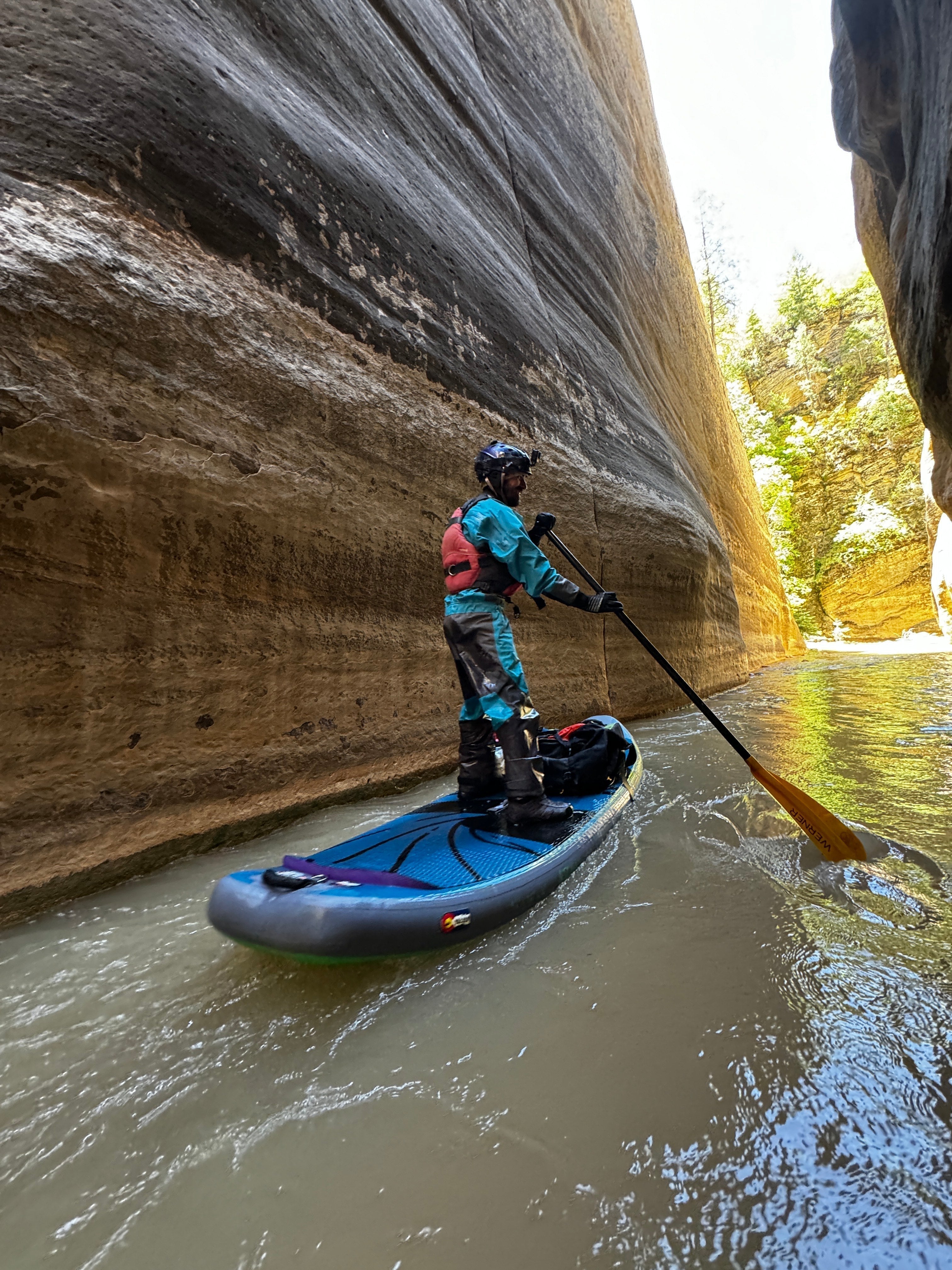
Against rock gardens, shallow water, and the general abuse of whitewater paddling, a quality inflatable outperforms any hard board. A hard board takes a direct rock hit and cracks, dings, or delaminates. A quality inflatable — built with fusion drop-stitch PVC and glued-and-welded rails — bounces off the same rock and paddles on.
This isn't theoretical. It's why every meaningful river SUP discipline runs inflatables. Hard boards simply cannot survive what rivers demand.
Safety
An inflatable board is softer on impact than a hard board — both for the paddler and for anyone nearby. On crowded waters, in surf, or in any situation where you might come into contact with other people or obstacles, an inflatable is meaningfully safer.
The Construction Quality Question
The inflatable SUP market spans a wide range of quality — from department store inflatables that are floppy and slow to boards that genuinely rival the feel of a hard board underfoot. The difference comes down to two things:
- Fusion drop-stitch: The industry standard for high-quality inflatables. PVC layers bonded directly to the internal drop-stitch threads — not glued on top. Lighter, stiffer, and won't delaminate after hard use.
- Glued and welded rails: The seam running around the perimeter of the board is the most stress-prone area. Quality boards use glued-and-welded rails (not just heat-welded seams), which hold up to whitewater, rocks, and years of use.
Hala uses fusion drop-stitch and glued-and-welded rails on every board in the lineup — paired with a 5-Year Warranty. See how Hala boards are built →
The Case for Rigid SUPs
Hard boards retain genuine advantages in two specific areas:
Pure Speed and Glide
In flatwater racing and long-distance touring at the competitive level, a high-end hard board has a slight edge in raw glide efficiency. The hull shape precision possible in a molded hard board is difficult to fully replicate in an inflatable. For recreational paddlers, this difference is imperceptible. For competitive racers chasing podiums at elite events, it can matter.
Dedicated High-Performance Surf
Purpose-built hard SUP surf shapes — designed specifically for high-performance ocean surfing — still have an edge in the highest-performance surf applications. If your primary use case is aggressive shortboard-style SUP surfing at a consistent break, a hard board designed for that purpose will be more responsive.
For everything else — rivers, recreational ocean, touring, fitness paddling, whitewater, camping, travel — a quality inflatable competes with or outperforms a hard board for the vast majority of paddlers.
Head-to-Head: Inflatable vs Rigid
| Category | Inflatable | Rigid |
|---|---|---|
| Storage | ✓ Any closet or car trunk | Requires dedicated space |
| Transport | ✓ Any vehicle, airline travel | Truck, roof rack, or trailer |
| River use | ✓ Built for it | Not recommended |
| Durability vs. rocks | ✓ Bounces off impacts | Dings, cracks, delaminates |
| Flatwater performance | Excellent (quality boards) | ✓ Slight edge at elite level |
| Setup time | 5–10 min to inflate | ✓ Immediate |
| Travel | ✓ Flies as checked luggage | No airline travel |
| Safety on impact | ✓ Softer on contact | Hard impact surface |
The Verdict
For the vast majority of paddlers — people who paddle lakes, rivers, ocean, and mixed environments — a quality inflatable SUP is the better choice. The practicality advantages are enormous, the durability advantage on rivers is decisive, and the performance gap with hard boards has been effectively closed by modern fusion drop-stitch construction.
The paddlers for whom a hard board is the right call are competitive flatwater racers chasing hundredths of a second, and dedicated surf SUP athletes running high-performance surf-only shapes. If that's you, you already know it. For everyone else, inflate and paddle.
Hala's Inflatable SUP Lineup
Every Hala board ships with a pump, bag, fin, and repair kit — and carries a 5-Year Warranty. Here's the full lineup.


Ready to Choose Your Board?
Browse the full Hala lineup — every board ships with pump, fin, bag, and repair kit, backed by a 5-Year Warranty.
Shop All Boards → Read the Full Buyer's Guide →




Laisser un commentaire
Ce site est protégé par hCaptcha, et la Politique de confidentialité et les Conditions de service de hCaptcha s’appliquent.