
How to Size a SUP Paddle: The Complete Modern Guide
Your paddle length affects everything: stroke efficiency, shoulder health, how quickly you can maneuver, and how tired you feel after two hours on the water. Most paddlers learn a sizing rule once and never revisit it — and most of those rules were written for flatwater racing, not the full range of SUP disciplines. This guide gives you the complete picture.
The Traditional Method (And Why It's Just a Starting Point)
The most common paddle sizing advice goes like this: stand the paddle upright next to you, and the handle should reach your wrist when your arm is raised straight overhead. Equivalently: take your height and add 8–10 inches.
This works reasonably well for flatwater and touring paddlers who are standing upright, taking long forward strokes, and maximizing distance per stroke. For that discipline, a longer paddle lets you reach further forward and pull through a fuller stroke.
But for whitewater? For surf? It's often the wrong advice entirely.
Sizing by Discipline
Flatwater and Distance Paddling
For calm lakes, touring, and fitness paddling, the traditional formula is your friend. A longer paddle supports an upright stance, longer reach, and efficient forward strokes. Add 6–10 inches to your height depending on your technique and how aggressively you paddle. More aggressive, lower-stance paddlers can go shorter even here.
Flatwater rule of thumb: Your height + 8 inches is a reliable starting point. Most adjustable paddles let you dial in from there.
Surf SUP
Surf SUP is dynamic — you're leaning forward on waves, pivoting, and generating short, powerful strokes. A paddle that's too long forces an awkward high-angle stroke when you're leaning down the face of a wave, kills your cadence, and makes it harder to brace.
Experienced surf SUP paddlers typically go 4–6 inches shorter than their flatwater setup, and some go shorter still. The old advice of "go tall for power" doesn't account for what your body is doing on a wave. Shorter lets you paddle faster, stay lower, and keep your shoulders in a healthier position.
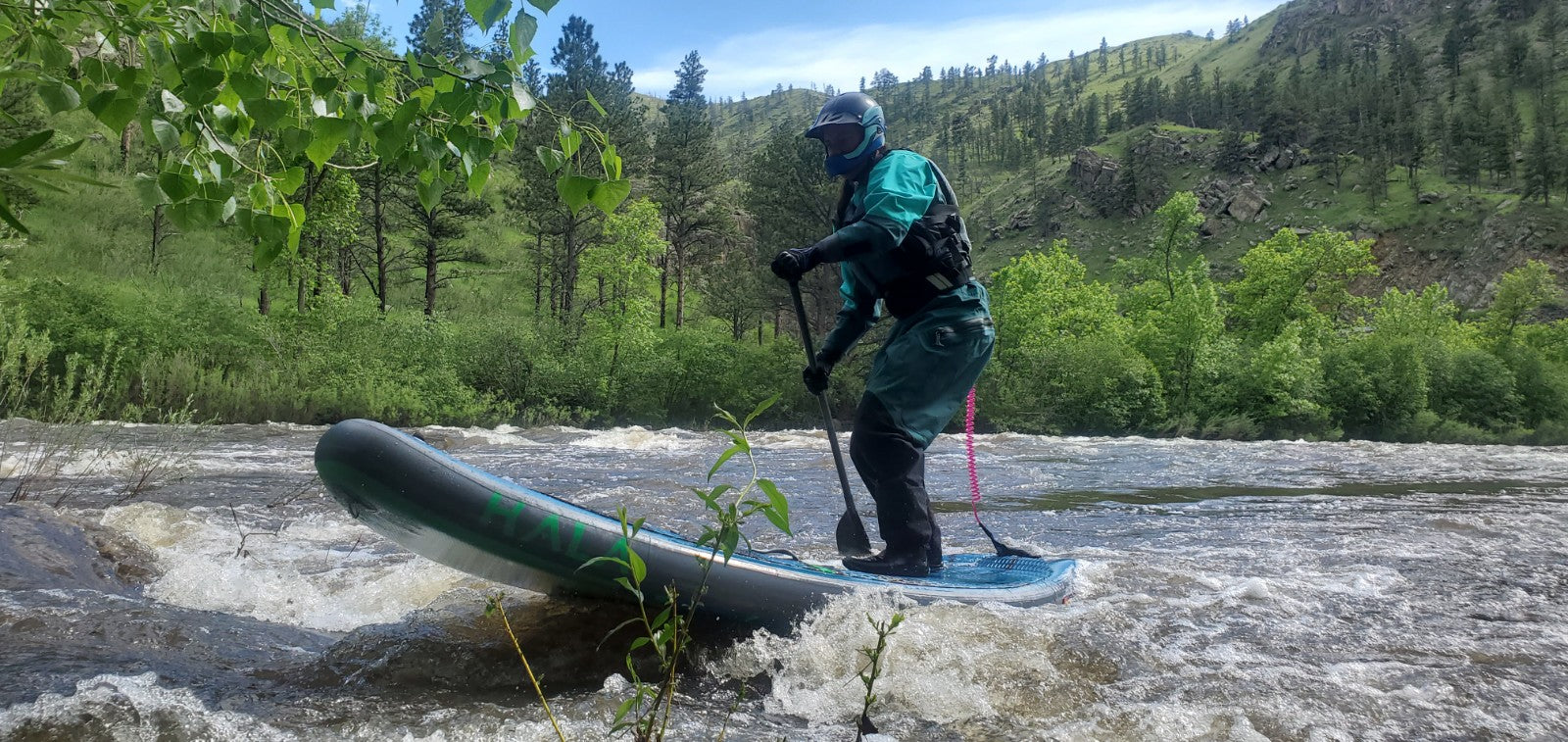
Whitewater SUP — The Elbow Method
Whitewater SUP has the most specific sizing needs — and the most to gain from getting it right.
Here's the method: place your paddle blade flat on the ground and stand next to it. Your elbow should be at roughly 90 degrees when you grip the shaft at its top. That's your whitewater paddle length.
Why it works: On a river, you're rarely standing straight up. You're in a low, athletic stance — hips dropped, ready to react. A shorter paddle means you don't have to stand up tall between strokes just to complete your stroke cycle. You stay low, stay balanced, and stay ready.
Two more critical reasons to go shorter on whitewater:
- Shoulder health. Repeatedly reaching high with a too-long paddle — especially on the bracing and draw strokes you use constantly on rivers — puts your shoulder in a vulnerable position. Shorter paddles keep your arms in a stronger, more protected range of motion. This is one of the most common causes of SUP shoulder injuries, and it's almost entirely preventable.
- Maneuverability. In tight channels, between rocks, and on river features, a shorter paddle gives you faster stroke turnover and more control. You don't need a long reach — you need a quick, powerful response.
Don't be surprised if your whitewater paddle ends up 4–8 inches shorter than your flatwater setup. That's normal, and it's correct.
The Adjustable Paddle Advantage
If you paddle multiple disciplines — even just flatwater on weekdays and rivers on weekends — a fixed-length paddle means you're compromising somewhere, every time.
An adjustable paddle solves this completely. You dial in the right length for the morning's session and go. Most quality adjustable SUP paddles adjust over a 10–15 inch range, which covers the full difference between your flatwater, surf, and whitewater setups.
The best travel paddles break down into 3 pieces, which adds the bonus of fitting in checked luggage or a board bag — ideal if you're taking your inflatable SUP on trips.
Pro tip: Mark your preferred lengths on the shaft with a paint marker. You'll dial in your setup in seconds without measuring every time.
Blade Shape Matters Too
Paddle length isn't the only variable — blade shape significantly affects how the paddle performs in different conditions.
- Larger teardrop blades move more water per stroke and are ideal for flatwater, touring, and distance paddling where long, powerful strokes are the goal.
- Smaller river blades are designed for quicker strokes, faster cadence, and better performance in current. The smaller surface area means less resistance when bracing or sculling in moving water — exactly what you want on a river.
If you're primarily a whitewater paddler, a river blade is worth the investment. If you split your time, the teardrop blade handles both well enough that most paddlers only need one.
Quick Reference: Sizing by Discipline
| Discipline | Sizing Method | Recommended Blade |
|---|---|---|
| Flatwater / Touring | Height + 8–10 inches | Teardrop (large) |
| Surf SUP | Height + 4–6 inches (or less) | Teardrop or river |
| Whitewater SUP | Blade on ground → elbow at 90° | River blade |
Hala's Paddle Lineup
Every Hala carbon paddle features a LeverLock® adjustable system, so one paddle covers all your disciplines. The current lineup:


River paddlers: All three paddles work with the whitewater elbow-method sizing above. If you're splitting time between flatwater and rivers, the adjustable range covers the difference — no second paddle needed.
Ready to Find Your Paddle?
All Hala carbon paddles are fully adjustable — dial in your length for the morning's session and go. Not sure which board to pair it with?
Shop Lock & Load → Find Your Board →



Laisser un commentaire
Ce site est protégé par hCaptcha, et la Politique de confidentialité et les Conditions de service de hCaptcha s’appliquent.