
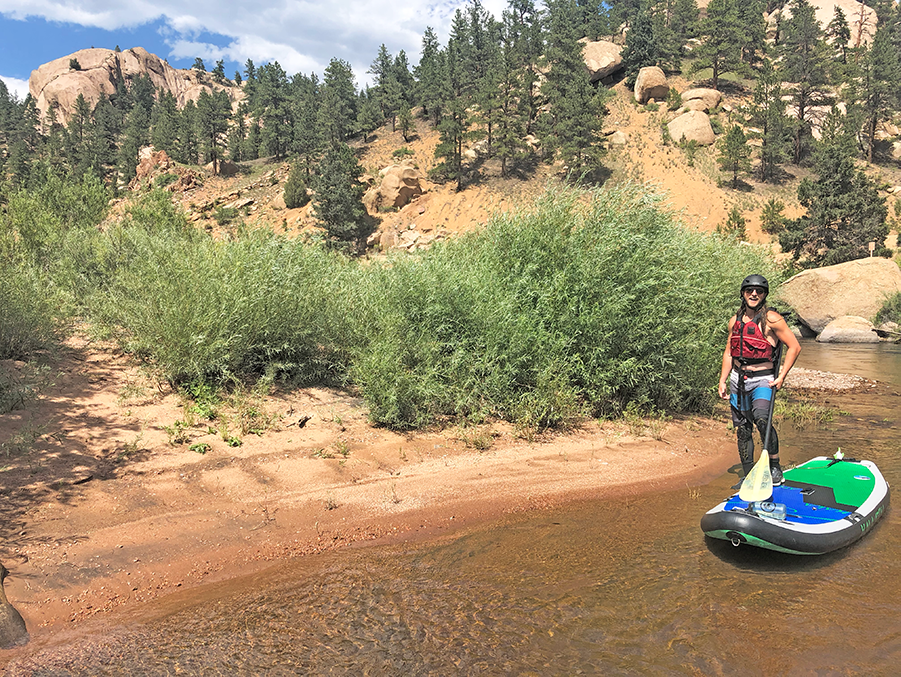
Adventure Report: Deckers
If you’re looking to level up from your flatwater SUP game, put Deckers on your radar!
Deckers is a section of the South Fork of the South Platte River that consists of beautiful scenery, refreshing water, and choose your own adventure-style rapids. And it is only an hour-long drive from Denver!
If you’re looking for a more mellow experience, you will find a suitable stretch if you launch in the river about a mile past the “Chutes,” just downstream of the footbridge at this pin.
If you’re looking for more action, you can scout the river from the dirt road and determine where you would like to launch. The road runs alongside the river the entire way and there are several parking lots with river access, so it is simple to cater your Deckers experience to meet your abilities.
Don’t put-in at any point upstream of this pin, as the farmers close to the town of Deckers have a reputation for placing dangerous fences in the river to discourage paddlers.
When I went, I put-in here and took-out at the South Platte Motel, just after the bridge here. It took us about two hours.

The Chutes
It is important to note that there is a class III section on this river called the “Chutes”. This section is located here. It will be fairly obvious from the road as you observe giant boulders and cliff walls constricting the river into a narrow slot. You can plan your river trip to do the class II section above it, the class I/II section below it, or do the entire stretch through it!
The entrance into the main chute is the most technical, as it requires the paddler to successfully navigate around rocks to direct their line into the chute.
If you’re not familiar with paddling in a current or steering through tight, shallow rapids, it might be best for you to take-out above or put-in below this section. If you’re comfortable with steering your board, compensating for currents, and ultimately potentially swimming in whitewater, then this is a pretty fun section!
Know Before You Go
Paddleboarding in rivers is a unique and extremely fun experience! Colorado has a plethora of rivers, outfitters, and instructors out there to help people experience this unique niche of SUP.
If you don’t have an understanding of river currents or general river safety, please take a course and understand the inherent hazards of a river before attempting to paddleboard in one.
Check the water level gauge.
High water means the water current will be swift and unforgiving. It will be dangerous for paddleboarding because it is likely the board (and/or you) could get pinned into boulders or strainers. Eddies are much more difficult to catch. Eddies are essential for recovering after you swim or even just exiting the river.
Low water will mean that the current will be slower and much more navigable. However, if the water is too low then there will be more rocks on the surface. If you’re on a paddleboard then you need to be ultra conscientious about whether or not the water is deep enough to prevent your fin from hitting the river bottom (cue the Stompbox!)
400 to 800 cubic feet per second (cfs) is a great level for paddleboarding. Check the current flow rate and get additional beta from American Whitewater here.

Gear You Will Need
Paddleboard
Any of Hala’s boards will do well on this river, as long as it is stable and easily maneuverable. We paddled the Radito, Atcha 96, and the Atcha 86.
Paddle
The best paddles for the river are ones that will float and have a strong, durable blade made from fiberglass, fiberlite, or carbon. Avoid plastic paddle blades. I use the Hala Grafik Carbon paddle and it has been one of the best paddles I’ve ever had. I’ve used it on rivers for over five years and it’s still going strong!
Helmet
It is imperative that you wear a helmet while stand up paddleboarding on a river. Hitting rocks with your head hurts. Wear a helmet.
Lifejacket
Wear a type III personal flotation device (PFD). Respect the river and protect yourself.
Shoes
Wear shoes that securely stay on your feet. Barefoot paddling may feel great while you’re on your board, but trust me, you’ll want shoes. You may encounter fishing hooks, slippery rocks, and broken glass on the banks!
Additional Recommendations
If you leash…
IF you wear a leash, it MUST be RELEASABLE. NO ANKLE LEASHES. The current in a river never stops, and if you were to get caught by your leash then you need to be able to release from it. It is impossible to release yourself from an ankle leash while under tension, so if you decide to wear a leash on a river, make sure it has a quick release and attach it to your waist where it will be easily reachable and releasable while under tension. Or consider not using a leash at all. This section would be fairly simple to recover your board if you had to swim to the bank.
Shin Guards
Not required, but recommended, are shin guards–especially if you decide to paddle in lower water. I personally use the G-Form shin guards but a lot of paddlers use WRSI shin guards. You can still have fun without them, but it’s always nice to prevent painful blows to the shins when you’re in shallow water.
Words of Advice
You will not have cell reception in this area so you must do all of your research beforehand. You will need a shuttle buddy or a bike to get back to your car once you reach the end of the trip.
Call up Altitude Paddleboards in Littleton, Colorado and chat with then to get more advice regarding this adventure! Otherwise, check out American Whitewater for any additional information you will need to embark on your Deckers paddle trip.
Be safe and remember to respect the river, be considerate of fly fishermen, leave no trace, and most of all, have fun!
Here’s a fun compilation Hala Athlete, John Blackshire (The Jib Mastah), made from our day paddling Deckers!
Blog written by Hala Team Rider Cami Swan.

Laisser un commentaire
Ce site est protégé par hCaptcha, et la Politique de confidentialité et les Conditions de service de hCaptcha s’appliquent.